It started with a petty Python script to unfollow Instagram accounts that no longer followed me back. A weekend hack. Maybe a couple of hundred lines of code.
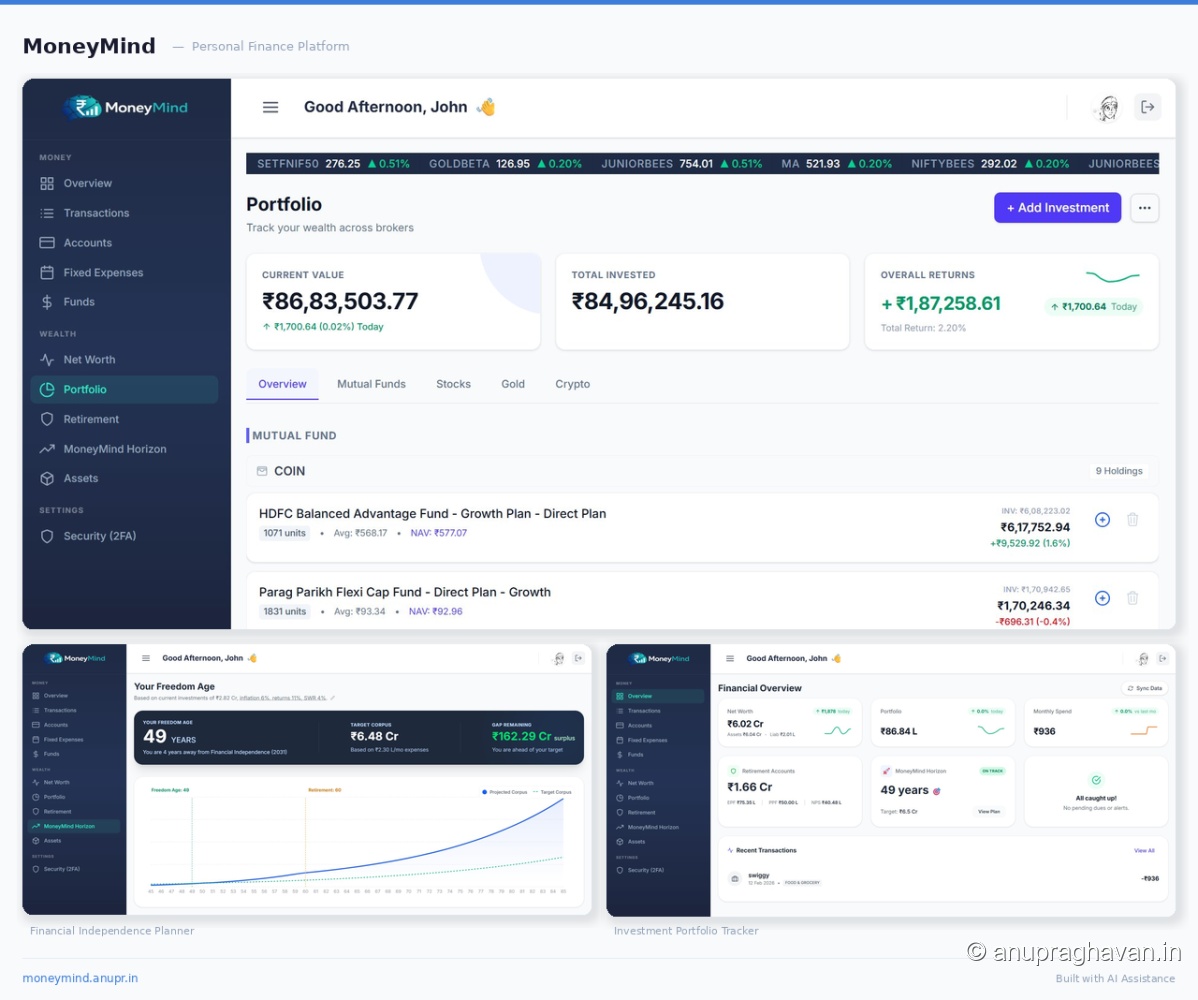
That script sparked something I didn't plan for. One project led to another: turning my ONVIF-enabled Dahua camera into a face-recognition system that announces visitors by name on Alexa, and eventually building MoneyMind - a full web application for personal finance that grew from automating one spreadsheet into a platform managing cash flow, market portfolios, financial independence targets, and post-retirement planning.
My tools - Google's Antigravity with Gemini 3 Pro and Anthropic's Claude (Sonnet and Opus), switching between the models for different tasks.
Along the way, I picked up a few lessons. Here are my TEN Revelations.
01AI Can Be a Better Version of You (Garbage In, Garbage Out)
The quality of what AI produces is directly proportional to the quality of what you feed it.
If you walk in with vague intentions, you'll get vague output. But if you arrive with a watertight set of requirements, detailed scenarios, edge cases identified, tech stack preferences clearly stated - then you get something remarkably close to what you actually wanted.
If you're building a UI-based application, having a clear picture of the information architecture, visual organisation, and user workflows before you start prompting makes a world of difference. Think of it less like instructing a machine and more like briefing a capable colleague who has zero context about your project.
02Human in the Loop
You should always be in the driving seat. Never let AI run unsupervised.
Be aware of what is being done, why it's being done a certain way, and how it's being achieved. Ask your AI assistant to present the pros and cons of one approach over another so that every decision is made in full awareness. In software development, this brings a level of predictability that you simply don't get when you let the model freestyle.
My experience with Gemini 3 Pro brought back memories of working with a senior engineer many years back - the kind of back-and-forth where you deliberate over why one design might offer better performance than another. That dynamic, thinking together rather than delegating blindly, is exactly the right relationship to have with your AI assistant.
03Iteration Beats Prompting Brilliance
The biggest productivity jump didn't come from writing the perfect prompt. It came from writing progressively better prompts.
Treat AI conversations like refactoring:
- First pass: Make it work.
- Second pass: Make it understandable.
- Third pass: Make it maintainable.
- Fourth pass: Make it yours.
Trying to get flawless output in one go is far slower than guiding the model through small, focused iterations. Control your enthusiasm to solve everything at once. Split your expectations and feed them through tight, deliberate prompts that produce predictable results.
04Context Is More Valuable Than Intelligence
AI doesn't fail because it's unintelligent. It fails because it's missing context.
Whenever the output was poor, the problem was almost always one of three things:
- Missing constraints
- Missing existing architecture
- Missing the intent behind a requirement
Once I started pasting existing code, describing the larger system, and explaining why something exists and not just what it does - the quality of output improved dramatically.
05AI Accelerates Decisions, Not Just Coding
I initially used AI purely for writing code. That's no longer where the biggest value lies.
I now use it far more for:
- Choosing architecture
- Estimating trade-offs
- Validating design assumptions
- Spotting edge cases early
The time saved in thinking exceeded the time saved in typing.
06Small Systems Become Big Very Quickly (Scalability)
AI removes friction from starting projects, which means you can accidentally build real products. This is exactly what happened with MoneyMind. What began as a script to automate one spreadsheet grew into a full-stack finance platform - and I barely noticed it happening.
Pause periodically and ask yourself one question:
If this had 1,000 users tomorrow, what would break first?
That single question improved my design quality more than any framework choice ever did.
07AI Is Excellent at Breadth, Humans at Intent
AI can generate ten approaches in seconds. But it has no idea which one matches your philosophy, your product's voice, or your user's expectations.
Your job shifts from writing code to defining taste.
You're no longer the fastest typist in the room - you're now the editor-in-chief.
08Debugging with AI Requires Discipline
AI will confidently fix symptoms instead of causes. It'll patch the surface and move on, leaving the real issue intact.
The habit that changed everything: identify how the issue manifests, ask the right questions, and interrogate the proposed fix before accepting it.
My standing rule:
Explain the root cause before proposing a fix.
The moment I started enforcing this, hallucinated fixes dropped massively.
09The Real Productivity Gain Is Emotional
The biggest change wasn't speed. It was momentum.
You stop postponing ideas because:
- Setup cost disappears
- Unknown territory becomes approachable
- Experimentation becomes cheap
AI doesn't just help you build faster - it reduces the fear of starting.
10You Don't Need to Know Everything, But You Must Understand Everything
I now write code in areas I previously avoided entirely. But the rule I hold myself to is strict:
If I can't explain the code after reading it, I don't ship it.
AI expands your capability. It does not transfer the responsibility. You still own every line that goes into production.
Finally - What We Built
The latest product of this journey - mine and my AI counterpart's - is called MoneyMind. It's a culmination of every personal finance pain point I've encountered over the years, and a long overdue replacement for my ageing, VBA-laden Excel file.
MoneyMind is currently in user-testing with friends and family. I plan to open-source the entire codebase in the near future.
If you're curious to take it for a spin and willing to share structured feedback, send me a message at hello@anupraghavan.in. I'll send you an invite code.
This is my first article. If any of this resonated, I'd love to hear about your own experience building with AI. The conversation is just getting started.